
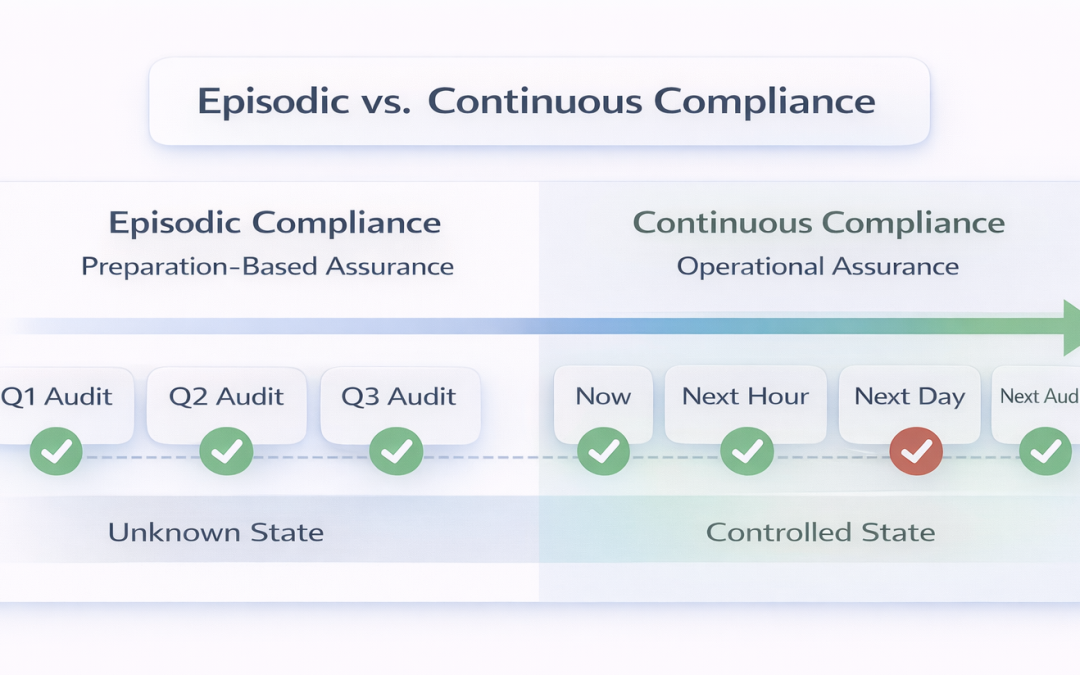
Compliance is not something you assemble, it is something you control.
In conversations with platform owners and compliance leaders, I often hear a familiar reassurance:
“We are compliant. We passed our audit.”
It sounds solid. Responsible. Controlled.
But in a landscape where Mendix applications are deployed weekly — sometimes daily — what does it actually mean to have been compliant six months ago?
That gap is where the real question begins.
Delivery Has Changed. Compliance Has Not.
Low-code platforms such as Mendix have dramatically shortened development cycles. With AI-assisted development now accelerating engineering output even further, release velocity continues to increase.
New features move from idea to production faster than ever before.
Yet in many organizations, compliance still operates on a periodic rhythm. Evidence is collected quarterly. Screenshots are assembled before audits. Change records are reviewed retrospectively.
Delivery is continuous.
Compliance remains episodic.
That structural mismatch is becoming unsustainable.
Because compliance is not a document.
It is a state.
And a state can change.
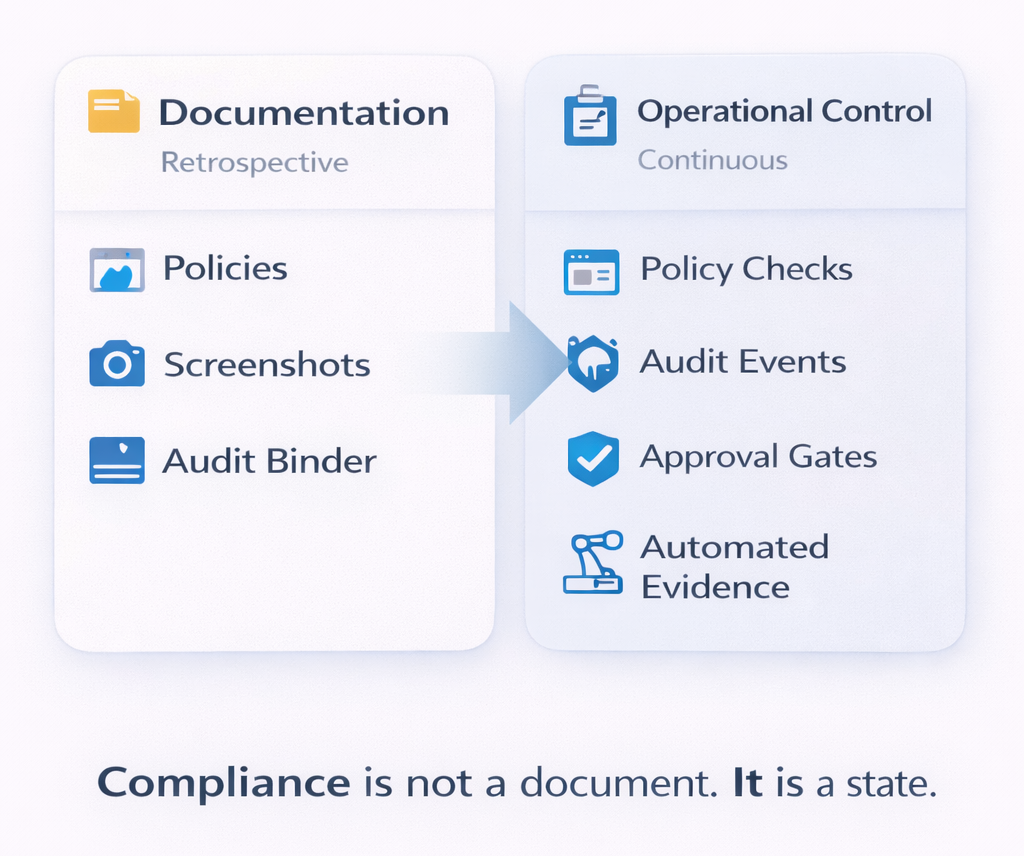
To actually be compliant at all times requires compliance embedded in operations, not just a series of documents and policies.
The Illusion of Audit Readiness
Across many enterprises, compliance confidence is based on preparation capability.
When auditors arrive, teams know how to:
- Extract deployment logs
- Collect approval records
- Demonstrate segregation of duties
- Assemble documentation
With effort, evidence can be produced.
But effort is not control.
If compliance requires preparation, then at any given moment between audits you do not fully know whether all applications still satisfy your control framework.
Policies may exist.
Standards may be defined.
But their enforcement is often indirect.
Nothing breaks immediately. But drift accumulates quietly — in access configurations, emergency fixes, skipped reviews, or undocumented changes.
And drift is rarely visible until someone asks for proof.
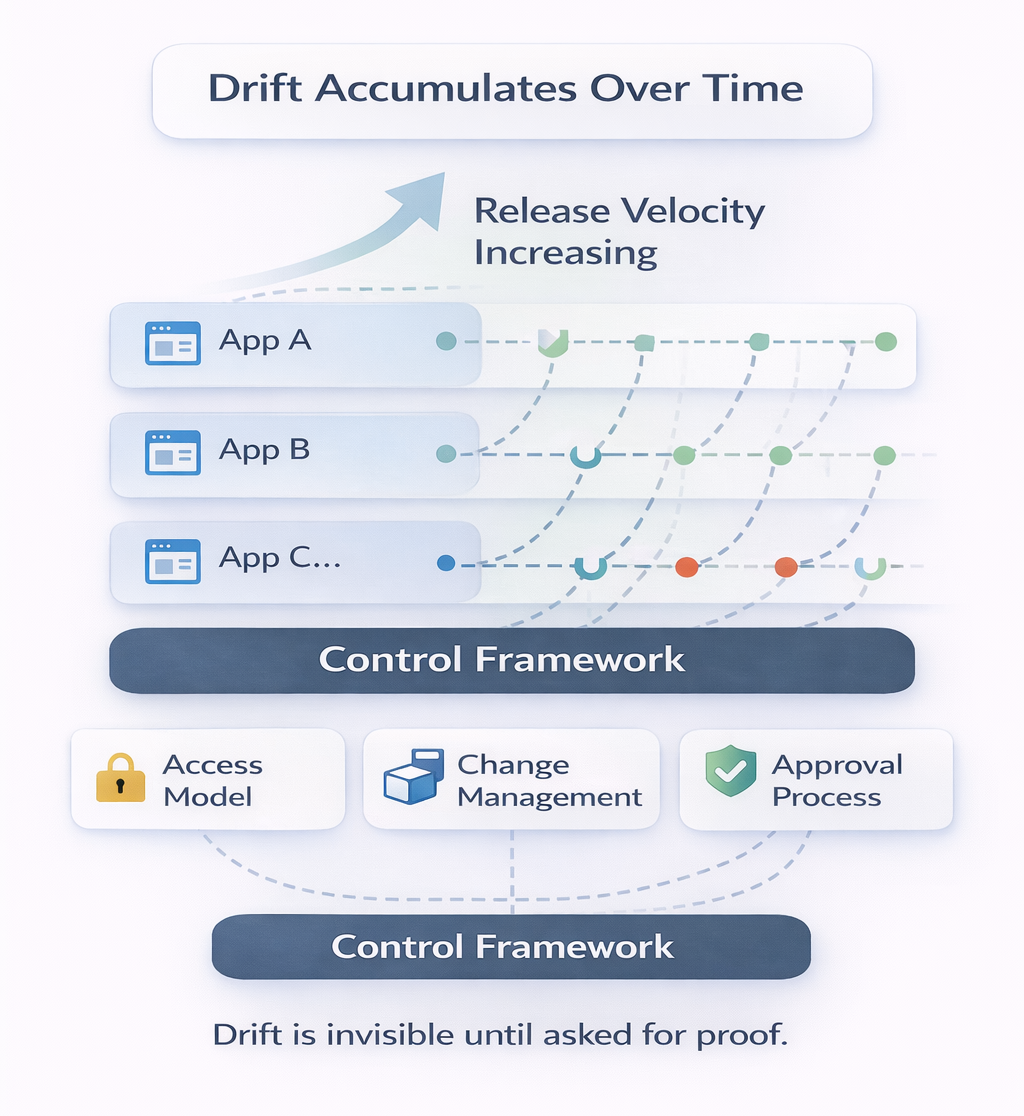
If you don’t monitor and enforce compliance continually, by the time you start your audit your risks, technical debt, and compliance gap can grow significantly.
What Continuous Compliance Actually Means
Continuous compliance does not mean more documentation.
It means operationalizing controls.
Instead of asking, “Can we demonstrate compliance?”
The better question becomes: “Is every application currently within defined control boundaries?”
That shift is subtle but profound.
Controls are defined explicitly.
Each control is mapped to measurable validation mechanisms — policy checks, audit events, approval gates.
Coverage is defined transparently.
Evidence is generated automatically.
Deviations surface immediately.
Compliance stops being something you assemble.
It becomes something you observe.
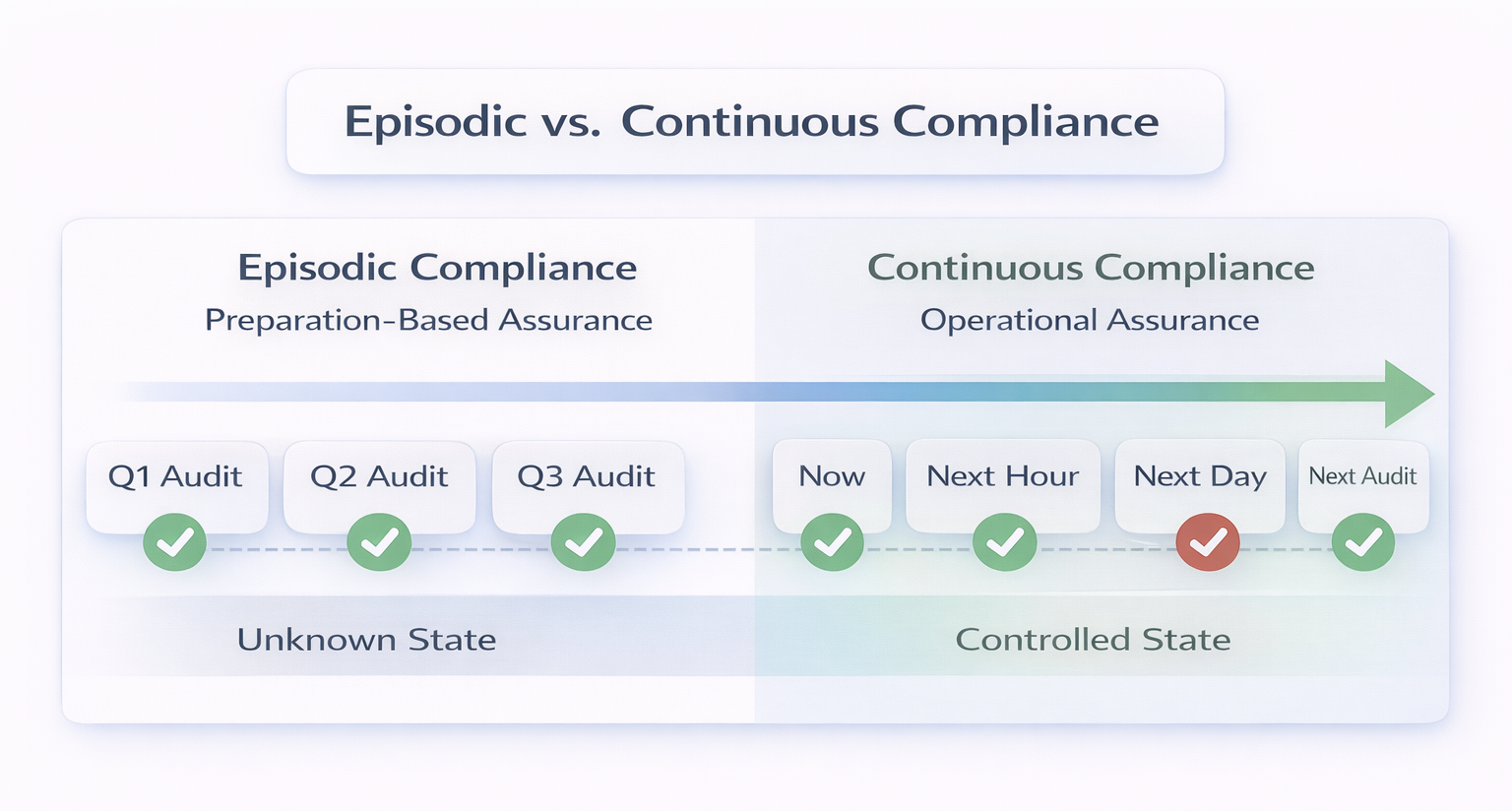
Being in control means knowing what the compliance state of your application landscape is at all times, now just at 2 or 4 moments in time across the year.
The Scale Problem
Consider a Mendix portfolio of 60 or 80 applications across multiple business domains.
Different teams.
Different release cadences.
Different risk profiles.
Can you answer, in real time:
- Which applications currently meet your change management requirements?
- Which environments have deviations from your access model?
- Which releases were deployed without documented approval?
- Where rollback registration is incomplete?
If the answer requires investigation, then compliance is reactive.
And reactive compliance does not scale.
The faster you deliver, the narrower your window for corrective action becomes.
Why This Matters Now
Regulatory pressure is increasing.
Board-level scrutiny of digital risk is intensifying.
Security incidents are measured in hours, not quarters.
At the same time, development throughput is accelerating.
In this environment, annual audit cycles are structurally misaligned with operational reality.
Passing an audit once per year does not guarantee controlled operation the other 364 days.
Continuous delivery requires continuous assurance.
The Governance Evolution
Mendix provides structural discipline through explicit domain models, managed environments, and governed deployment flows.
But structure alone does not guarantee compliance at scale.
Compliance must be embedded into the lifecycle itself.
A mature governance model evaluates applications continuously against defined controls.
Coverage is explicit — full, partial, or mapped.
Evidence is produced automatically.
Exceptions are visible immediately.
Remediation becomes structured rather than reactive.
Control is no longer a retrospective activity.
It becomes part of daily operations.
The Real Question
The question is not whether your organization can pass an audit.
The question is whether you can demonstrate, at any moment, that your Mendix portfolio remains within control boundaries.
If compliance requires preparation, it is not continuous.
And if it is not continuous, you are depending on timing rather than control.
In the next article, we will examine how security shifts from reactive vulnerability management to built-in control within the Mendix lifecycle.
Because defining policies is one thing.
Operating them continuously is another.
— Andrew Whalen
Founder, Blue Storm
Recent Comments