
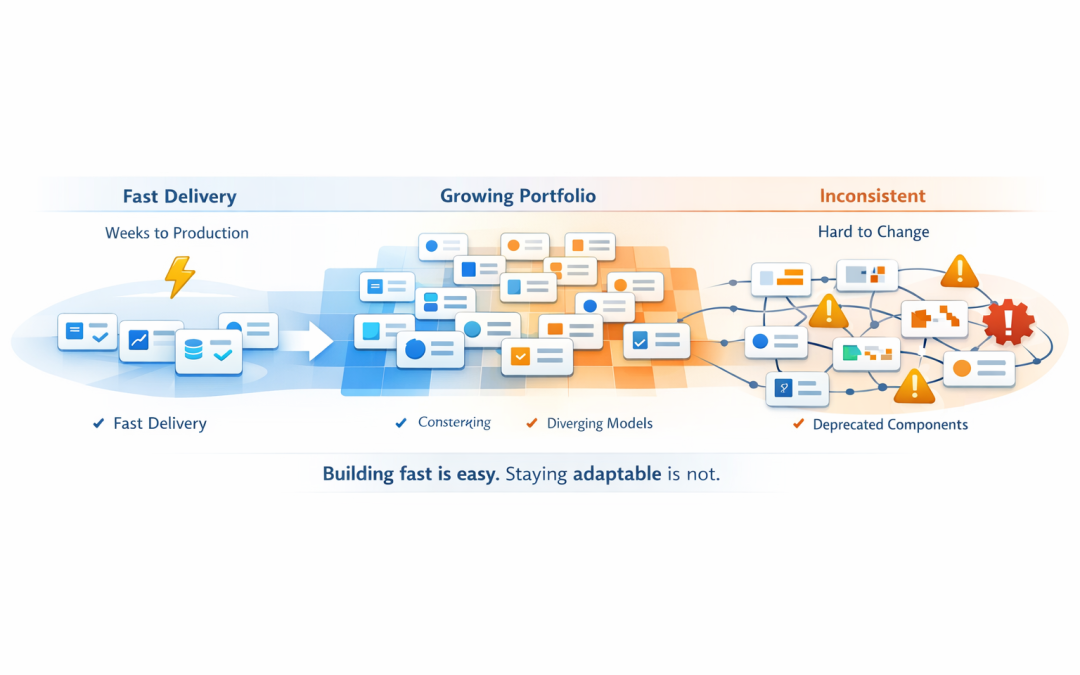
In the early stages of a Mendix journey, speed is the dominant metric.
Ideas move quickly.
Business cases are validated rapidly.
Applications reach production in weeks instead of months.
The platform proves its value.
But over time, another question begins to surface.
Not whether we can build fast —
but whether we can still change what we have built.
That shift marks the difference between growth and accumulation.
And accumulation, unmanaged, becomes constraint.
The Silent Cost of Success
When Mendix adoption expands, portfolios grow organically.
New teams build new applications.
Departments create solutions tailored to their own needs.
Integration patterns evolve independently.
Naming conventions diverge.
Reusable components are recreated instead of shared.
Nothing appears broken.
Each application works.
But coherence begins to fade.
Quality degradation rarely happens through catastrophic failure.
It happens incrementally — through small deviations that compound over time.
And compounding inconsistency is expensive.
What Maintainability Actually Means
Maintainability is often reduced to code quality metrics or refactoring discipline.
Those are important.
But at portfolio scale, maintainability becomes structural.
It includes:
- Consistent architectural patterns
- Standardized integration approaches
- Controlled domain model evolution
- Transparent dependency management
- Predictable deployment practices
Maintainability is not about how clean a single app looks today.
It is about whether the portfolio remains adaptable tomorrow.
The Drift Problem
As applications evolve independently, variation increases:
- Similar business logic is implemented differently across apps.
- Data entities with the same meaning are modeled differently.
- Shared services are bypassed for convenience.
- Deprecated components remain in use.
Each decision may be reasonable in isolation.
But collectively, they reduce agility.
Eventually, change requests become slower.
Impact analysis becomes harder.
Modernization initiatives become riskier.
Technical debt is rarely dramatic.
It is gradual.
And gradual debt is the hardest to detect early.
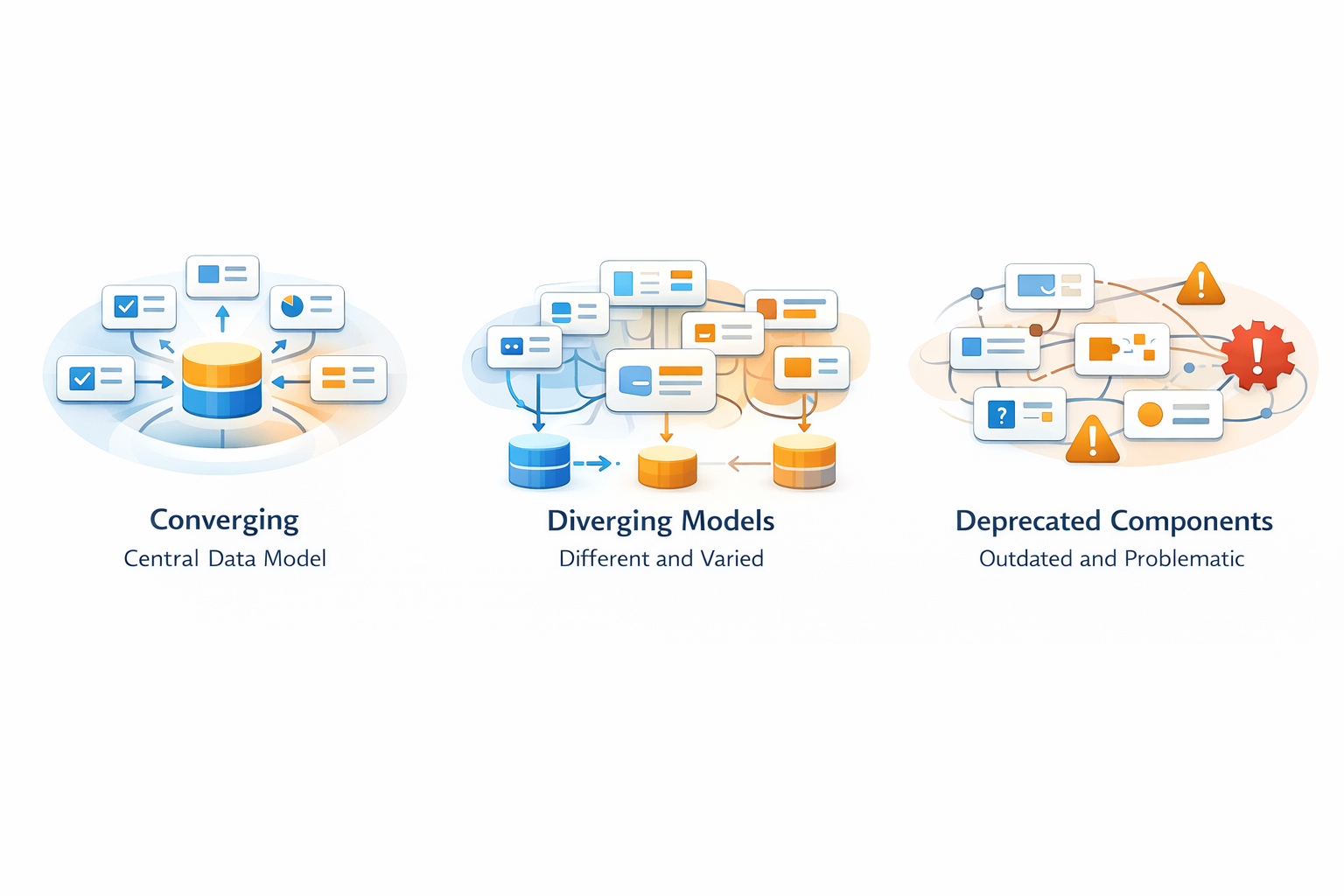
In the traditional reactive qualty approach, issues are detected when doing upgrades, during periodic reviews, or when problems become too big to ignore.
Growth Without Governance
In many organizations, quality governance is informal.
Architectural guidelines exist.
Best practices are documented.
Senior developers review major initiatives.
These mechanisms help.
But they rely on vigilance and memory.
As team count increases and delivery velocity accelerates — particularly with AI-assisted development — reliance on manual oversight becomes fragile.
Variation outpaces supervision.
And inconsistency becomes systemic.
The Portfolio Perspective
Now consider a Mendix landscape of 90 applications built over several years.
Can you answer, in real time:
- Which applications adhere to your architectural standards?
- Where naming conventions or integration patterns diverge?
- Which apps rely on deprecated components?
- Where model complexity is increasing beyond maintainable thresholds?
If the answer requires manual investigation, then quality governance is reactive.
And reactive governance does not scale with portfolio growth.
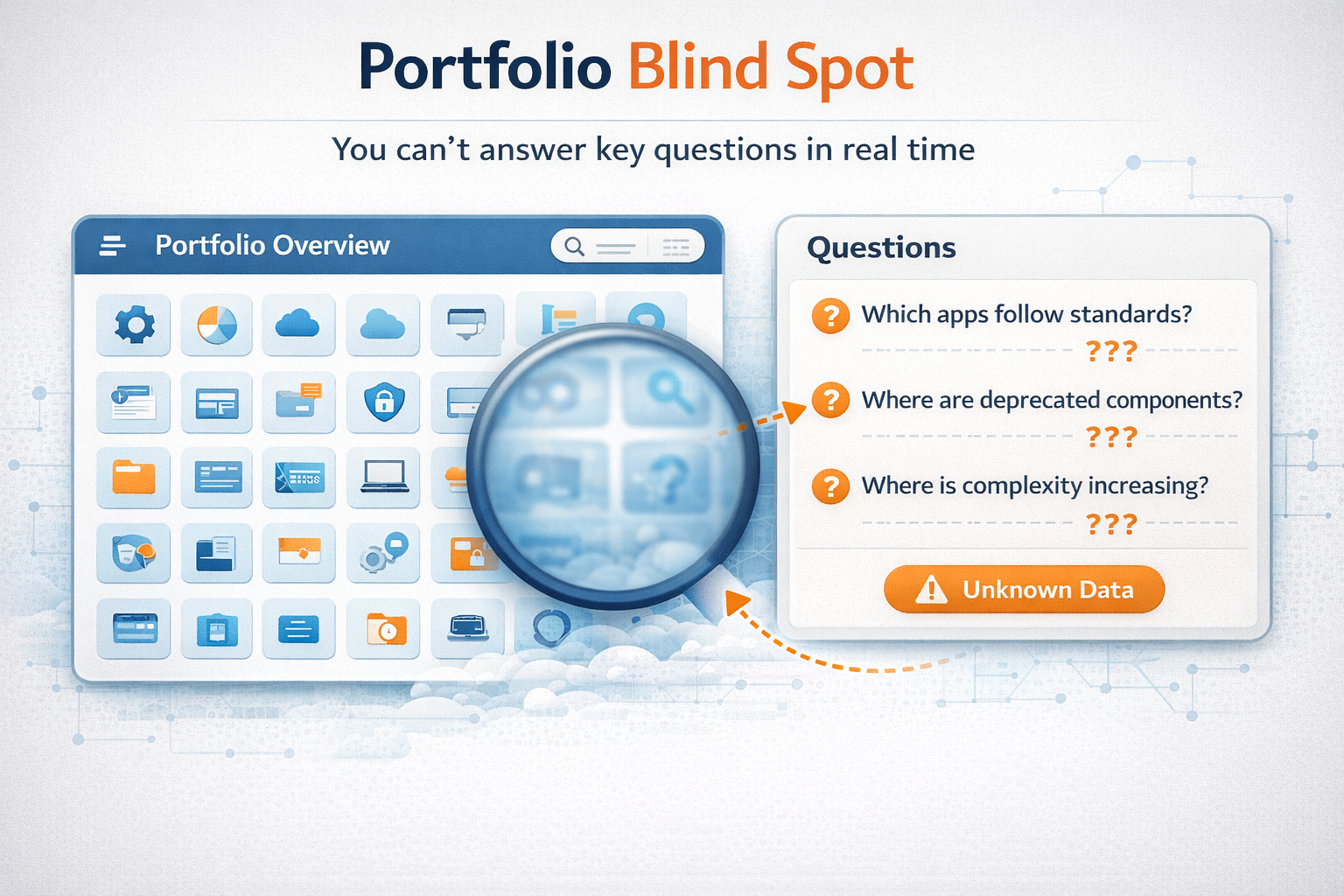
At scale, multiple apps can slowly drfit from your qualty architecture (development standards, component usage, architectural standards) leading to systemic risk.
From Guidelines to Operational Standards
The transition from informal governance to sustainable maintainability requires operationalization.
Architectural and quality standards must become explicit controls.
Each standard is defined clearly.
Each is mapped to measurable validation mechanisms — structural checks, complexity thresholds, dependency monitoring, lifecycle audit events.
Coverage is transparent.
Evidence is produced automatically.
Deviations surface immediately.
Quality becomes observable.
Maintainability becomes measurable.
And leadership gains visibility before complexity becomes constraint.
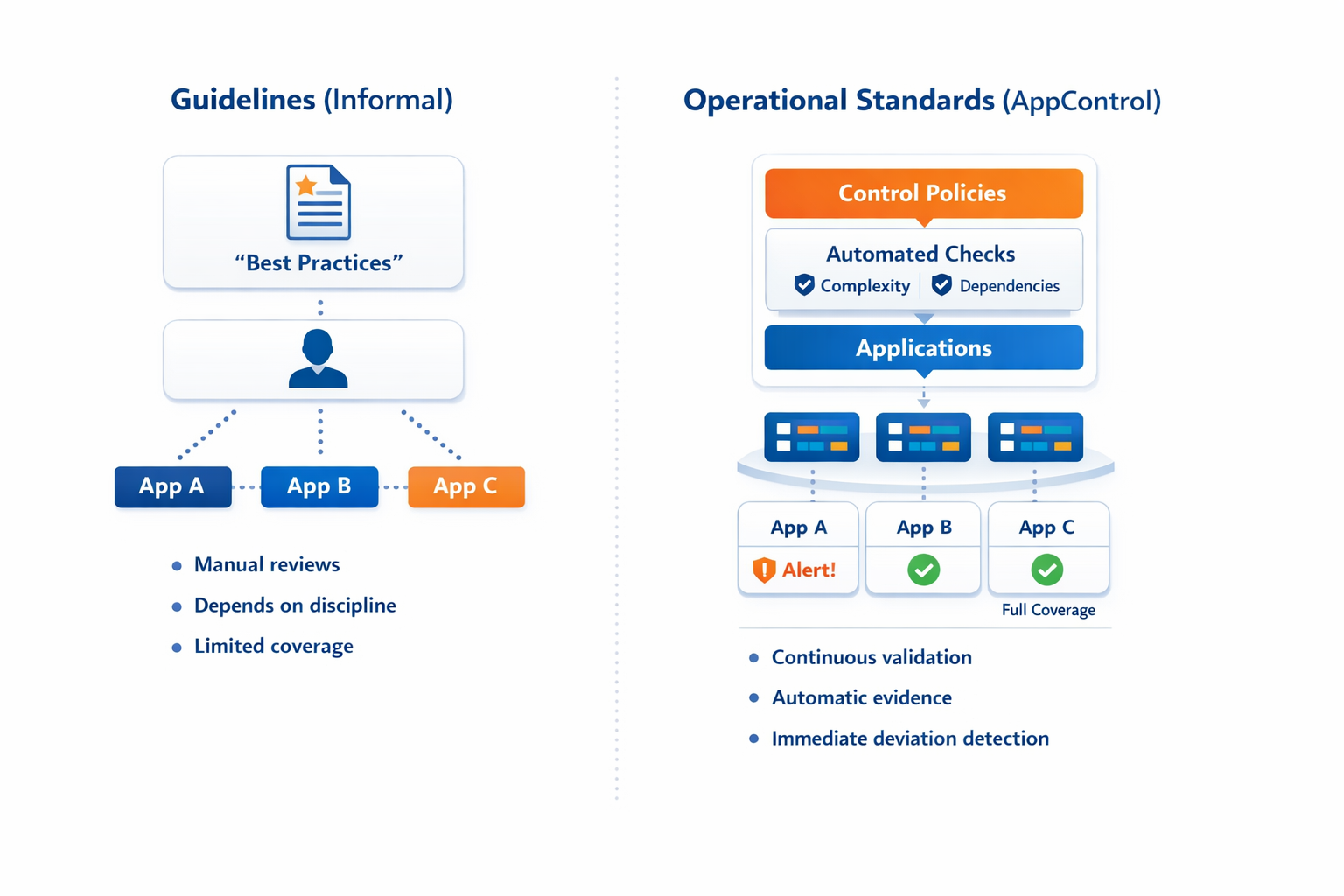
When your quality standards and architecture are translated into active controls, maintainability becomes a continual and operational reality.
Why This Matters Now
Mendix adoption is accelerating.
AI-assisted development increases throughput further.
Application portfolios are growing faster than ever.
The risk is no longer slow delivery.
The risk is creating a landscape that becomes progressively harder to change.
Sustainable digital transformation depends not only on how fast you build —
but on how reliably you can evolve.
The Real Question
The question is not whether your teams follow best practices.
The question is whether deviation from those practices can occur without you knowing.
If architectural drift is discovered only during modernization efforts, it is already costly.
If maintainability is measured continuously, portfolio growth becomes sustainable.
Because building quickly is an achievement.
Remaining adaptable at scale is a capability.
And in an environment of accelerating development, adaptability is control.
— Andrew Whalen
Founder, Blue Storm
Recent Comments