
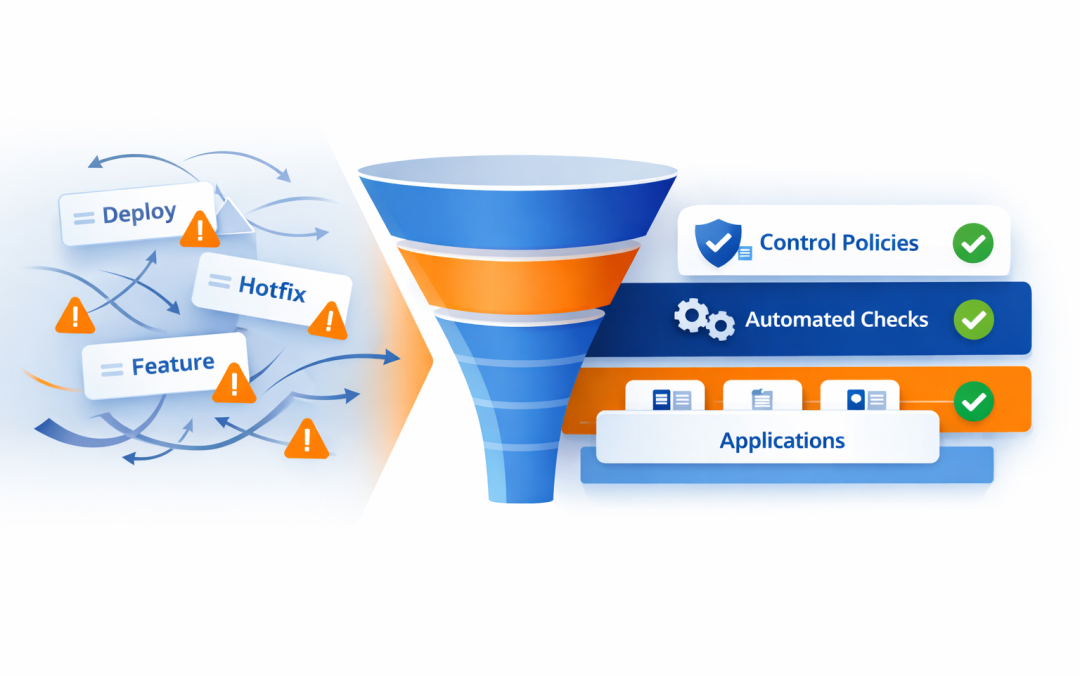
Developers in regulated environments operate under dual pressure.
Delivery cycles are short.
Business expectations are high.
Features must move from idea to production quickly.
At the same time, every change must be traceable.
Every deployment must be approved.
Every environment must remain within defined control boundaries.
Compliance is not a quarterly event.
It is an ongoing condition.
And yet, in many Mendix landscapes, compliance still feels episodic.
That tension is where the real problem begins.
Delivery Is Continuous. Compliance Often Is Not.
Modern Mendix teams deploy frequently.
Stories move through pipelines rapidly.
Hotfixes are applied under operational pressure.
But compliance mechanisms often operate outside this flow.
Evidence is gathered before audits.
Approval histories are reconstructed manually.
Access reviews are performed periodically.
Deviation detection happens after release.
The result is familiar to most developers working under ISO 27001, SOC 2, DORA, or internal governance frameworks:
You spend time proving that what you built was compliant — instead of knowing it already is.
This introduces friction, uncertainty, and unnecessary cognitive load.
Because the core question remains unanswered:
At this moment, is the application still within defined control boundaries?
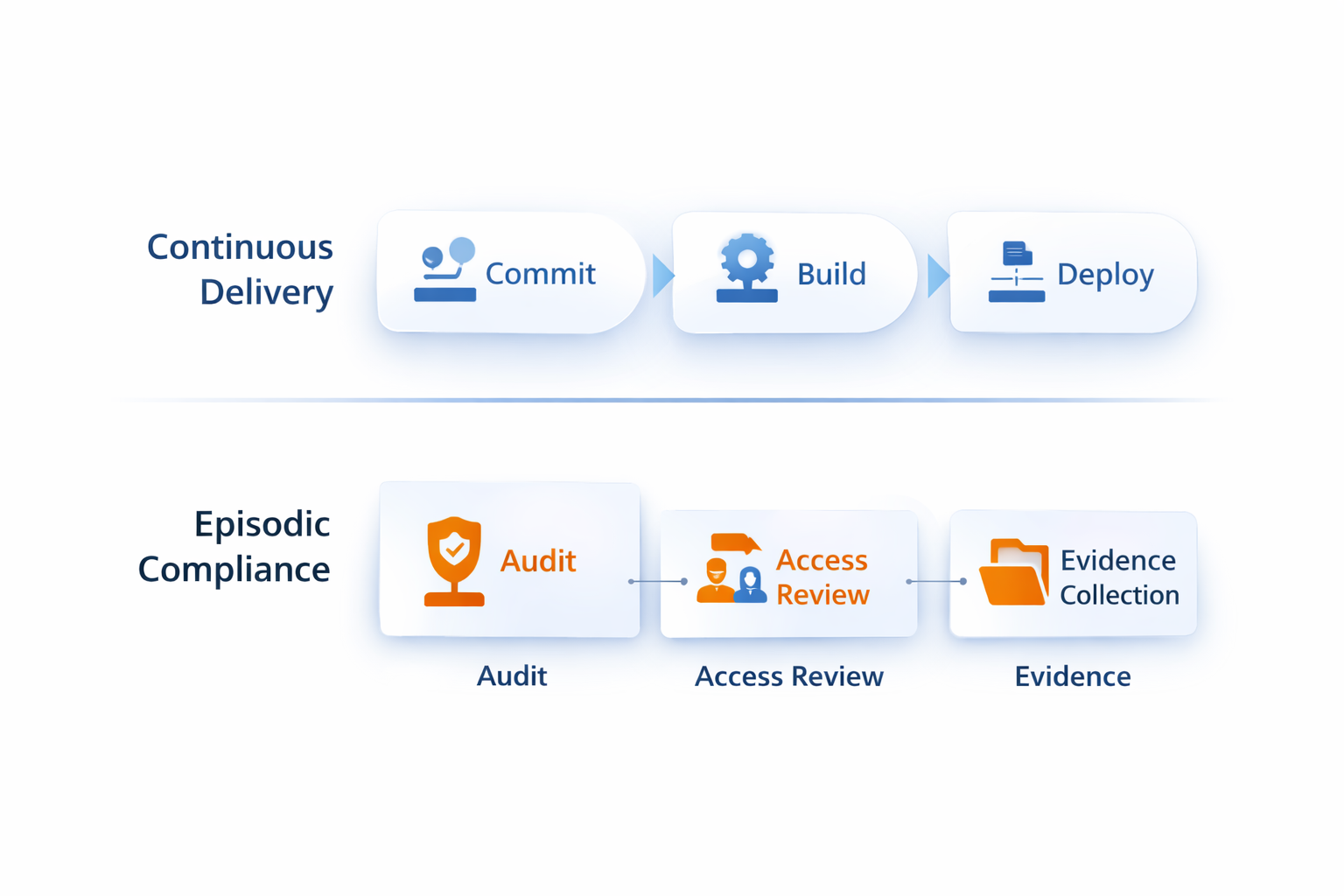
Traditional approaches to compliance are reactive and don’t fit well with the high pace of development expected from low code or AI-powered development teams.
What “Continuous” Actually Implies
Continuous compliance is not about producing more documentation.
It is about embedding validation into the lifecycle itself.
Every relevant compliance requirement must be translated into something technically observable.
For example:
- Change management requirements become enforceable deployment approval checks.
- Segregation of duties becomes role-based validation against environment access models.
- Rollback registration becomes a mandatory audit event tied to release flows.
- Configuration policies become automated validation rules evaluated continuously.
The shift is architectural.
Instead of relying on retrospective evidence collection, the system continuously evaluates whether defined controls remain satisfied.
Compliance becomes state-based, not document-based.
The Developer Experience Shift
When controls are external to development, they create interruptions.
An auditor asks for screenshots.
A compliance officer requests deployment history.
An exception must be explained weeks after the fact.
When controls are embedded structurally, the experience changes.
Deployment cannot proceed without required approvals.
Environment separation is validated automatically.
Policy violations surface immediately.
Evidence is generated without manual intervention.
You do not have to prepare for audits.
The system produces proof continuously.
For developers, this reduces context switching. It removes last-minute compliance stress. It replaces uncertainty with clarity.
Boundaries become explicit.
And explicit boundaries improve engineering discipline.
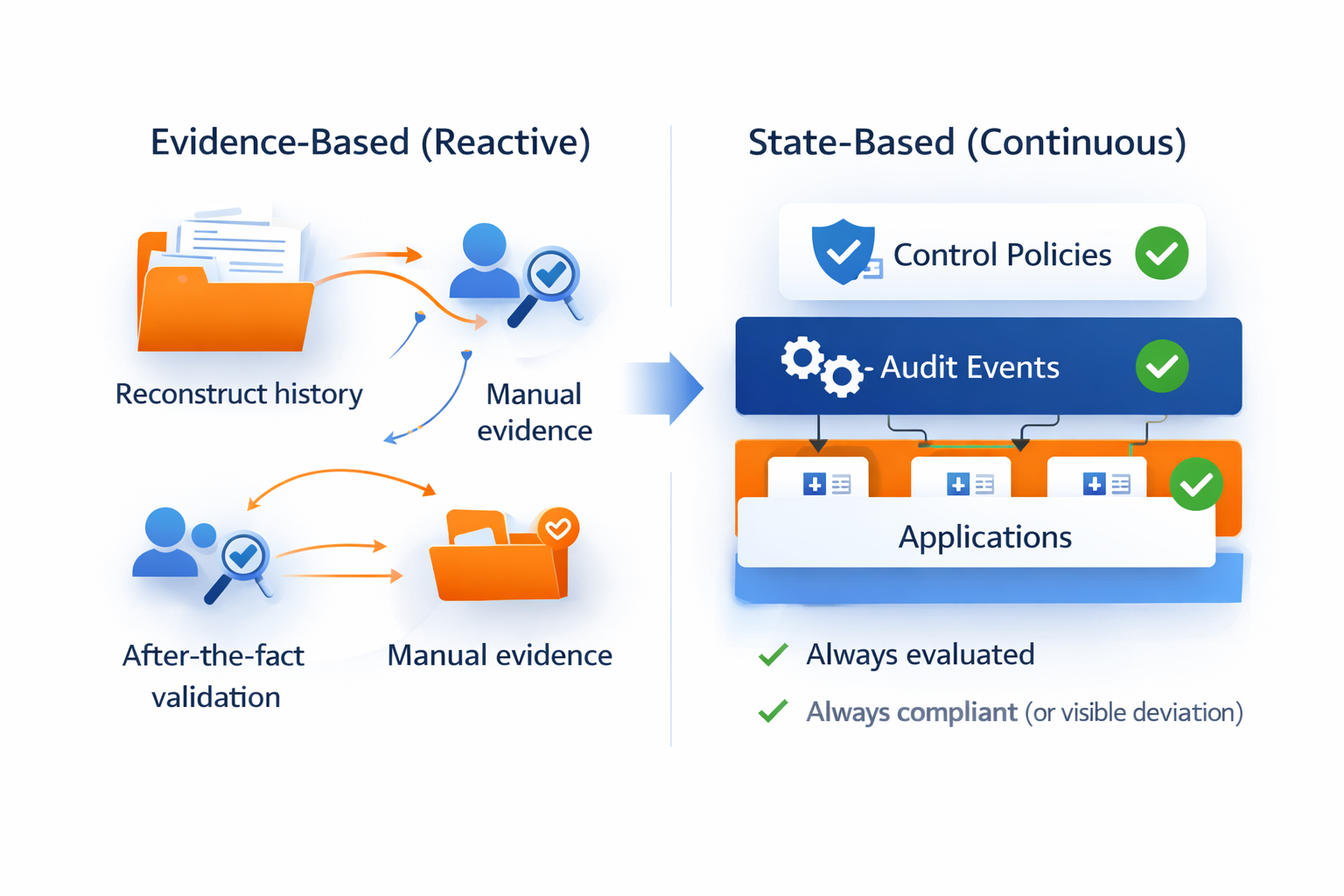
As compliance moves from evenidence based to state-based, it aligns better with engineering – it becomes a programmed output instead of the result of best effort.
Working in Regulated Contexts
In highly regulated environments, confidence is not optional.
If you work in financial services, healthcare, public sector, or critical infrastructure, the cost of non-compliance is material.
But the real strain is often psychological.
You may believe you followed the right process.
You assume approvals were recorded correctly.
You expect access roles are still configured as intended.
Yet without continuous validation, certainty depends on assumption.
Continuous compliance removes that ambiguity.
If coverage is defined explicitly — full, partial, or mapped — you understand precisely which controls apply to your application.
If every relevant audit event is generated automatically, you do not depend on memory or manual logging.
If deviations are visible immediately, remediation happens before risk compounds.
Confidence becomes measurable.
Compliance as Craftsmanship
High-quality engineering is not only about elegant domain models or optimized performance.
It includes disciplined change management.
It includes predictable deployment behavior.
It includes demonstrable adherence to defined standards.
When compliance is embedded into the lifecycle, craftsmanship expands beyond functionality.
You design features knowing:
- Required approvals will be enforced.
- Required logging will be captured.
- Required segregation will be validated.
- Required evidence will exist.
You build inside a controlled system.
And a controlled system enables focus.
Because mental bandwidth is no longer consumed by uncertainty about governance alignment.
Scaling Across a Portfolio
Now consider a Mendix portfolio of 70 applications developed by multiple teams.
Without continuous evaluation, small deviations accumulate:
An approval bypassed under time pressure.
A rollback not formally registered.
An access role expanded temporarily and never reduced.
Individually, these seem manageable.
At scale, they create systemic drift.
Continuous compliance ensures that each application is evaluated against defined controls automatically and repeatedly.
Not before an audit.
Not after an incident.
But continuously.
For developers, this means consistency across teams.
You operate within the same observable control framework as everyone else.
That predictability increases alignment and reduces friction during cross-team collaboration.
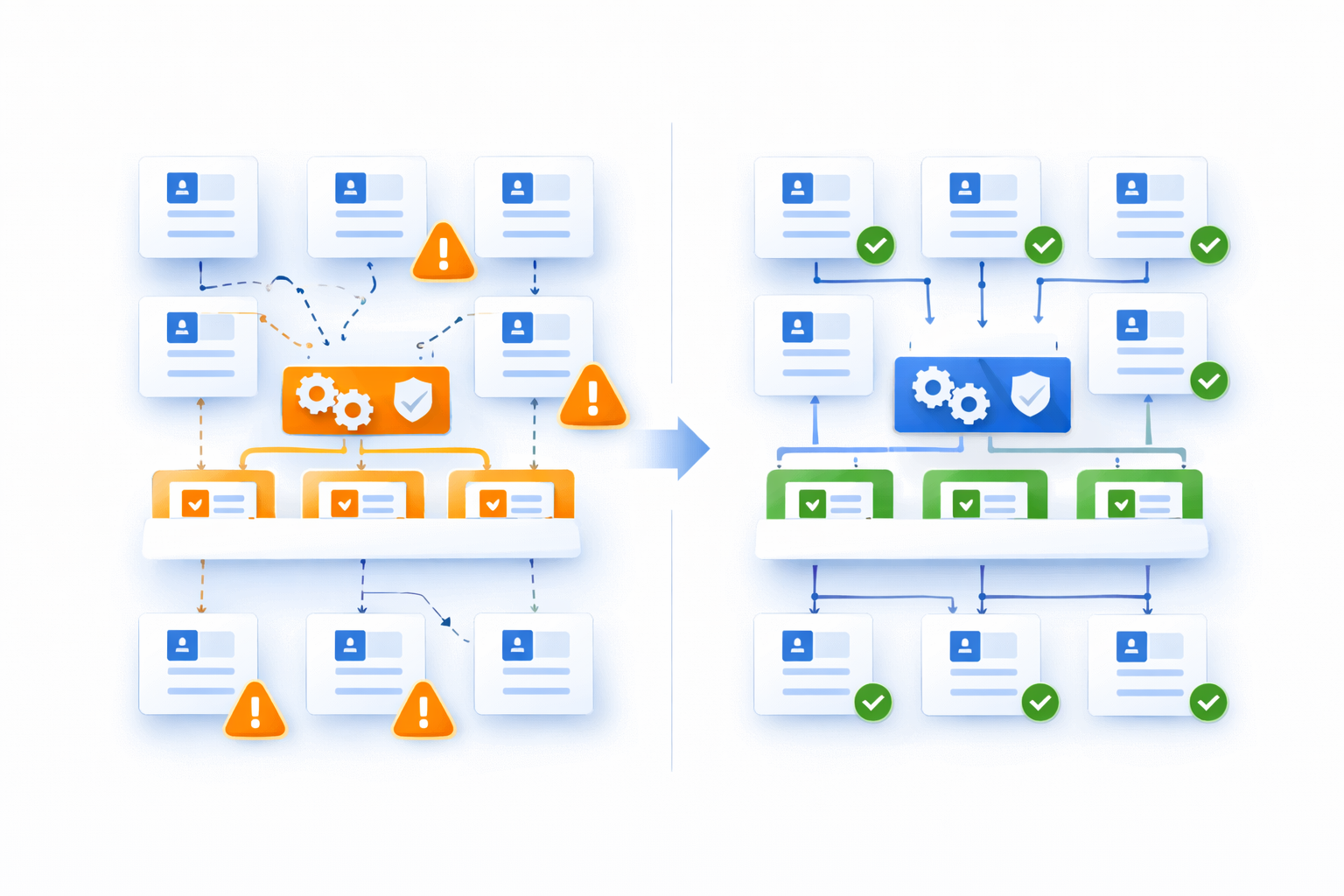
Because teams operate within the same observable control framework as everyone else, systemic drift is not allowed to accumulate.
Why This Matters Now
AI-assisted development accelerates output.
Low-code reduces implementation friction.
Feature throughput increases.
In this environment, the cost of retrospective validation grows.
If compliance depends on reconstructing history, the effort scales with velocity.
If validation is embedded, effort remains stable regardless of throughput.
Continuous compliance is therefore not primarily about governance teams.
It is about enabling developers to work quickly in regulated environments without accumulating invisible risk.
The Real Question
The question is not whether your organization has compliance policies.
The question is whether deviation from those policies can occur without immediate visibility.
If the answer is yes, compliance remains reactive.
If the answer is no — because validation is embedded directly into the Mendix lifecycle — compliance becomes structural.
And structural compliance gives developers what they value most:
Clarity.
Predictability.
Confidence.
Because in regulated environments, delivering features is expected.
Delivering them with demonstrable control is professional engineering.
— Andrew Whalen
Founder, Blue Storm
Recent Comments